
The Ultimate Guide to Sourcing Pet Products: Private Label vs. White Label
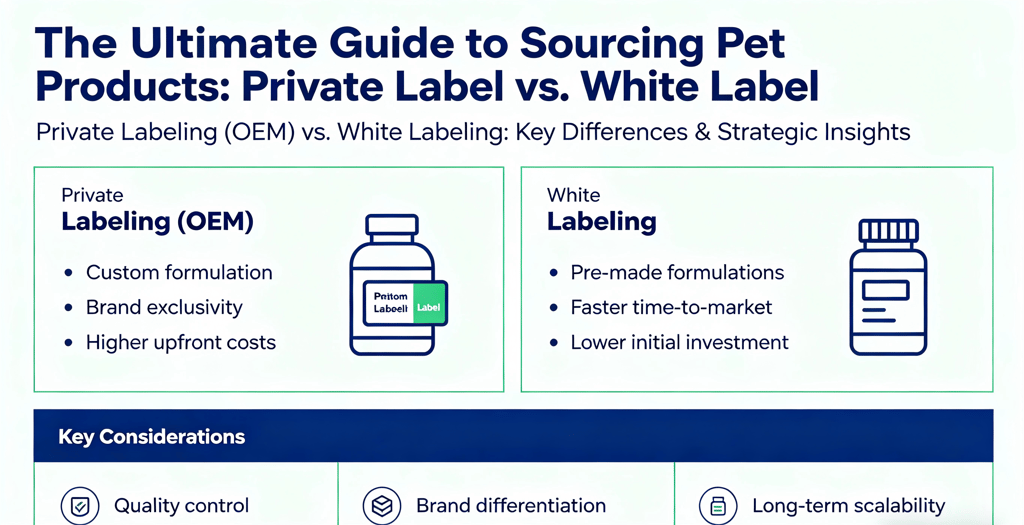
Starting or scaling a successful pet brand comes with one critical, foundational decision: How do you manufacture your products? While brilliant marketing brings customers to your digital storefront, the quality, functionality, and uniqueness of your inventory are what keep them coming back. For most modern e-commerce brands and retailers, the choice ultimately comes down to two primary manufacturing strategies: Private Labeling (OEM) versus White Labeling. Understanding the distinct advantages and limitations of each is crucial for protecting your bottom line and building long-term brand equity.
4/22/2026
Understanding White Labeling
White labeling involves purchasing generic, pre-manufactured products from a supplier and simply applying your brand's logo or custom packaging to them. The factory produces the exact same item for multiple different brands.
The Pros:
Speed to Market: Since the products are already designed and often in stock, you can launch your store very quickly.
Lower MOQs: Minimum Order Quantities are typically lower, making it accessible for startups with limited initial capital.
The Cons:
High Competition: You are selling the exact same product as potentially dozens of other competitors. The only way to compete is often by lowering prices, which hurts profit margins.
Zero Product Control: You cannot improve the product's design or fix functional flaws.
Understanding Private Labeling (OEM)
Private labeling, often facilitated through an Original Equipment Manufacturer (OEM), allows you to customize the product itself. You work directly with a factory to modify the design, materials, colors, dimensions, and functionality to meet your brand's exact specifications.
The Pros:
Total Brand Differentiation: Your product is unique to your brand. You aren't just selling a dog toy; you are selling your specific, engineered dog toy.
Higher Profit Margins: Unique, high-quality products command premium pricing. Customers are willing to pay more for thoughtful design and superior materials.
Solving Customer Pain Points: You can read reviews of competitor products and instruct your OEM partner to fix those specific flaws in your version (e.g., reinforcing the seams on a plush toy).
The Cons:
Higher Investment: Custom molds and specific material sourcing usually require higher MOQs and slightly longer initial lead times for production.
How to Choose the Right Manufacturing Partner
If you want to build a sustainable, scalable pet business, Private Labeling (OEM) is widely considered the superior long-term strategy. However, executing this strategy requires a highly reliable factory partner. When vetting suppliers, look for the following criteria:
Stringent Quality Control & Material Transparency: Pets chew, lick, and swallow parts of their toys. Your factory must provide transparent sourcing for non-toxic, safe materials and have strict quality assurance protocols on the assembly line.
Customization Capabilities: Ensure they have in-house prototyping and the ability to create custom molds efficiently. They should be willing to sign NDAs (Non-Disclosure Agreements) to protect your intellectual property.
Supply Chain Stability: In international trade, delays cost money. An experienced export manufacturer will have streamlined logistics, clear communication channels, and a proven track record of meeting production deadlines.
Conclusion
Building a standout pet brand in today's competitive landscape doesn't mean you have to build your own factory. By leveraging the right OEM services, you can deliver exceptional, customized quality that scales with your business. Choose your sourcing strategy wisely, and prioritize partners who view your success as their own.
Follow Us
© 2026. Merepet All rights reserved.